Customer Service Training
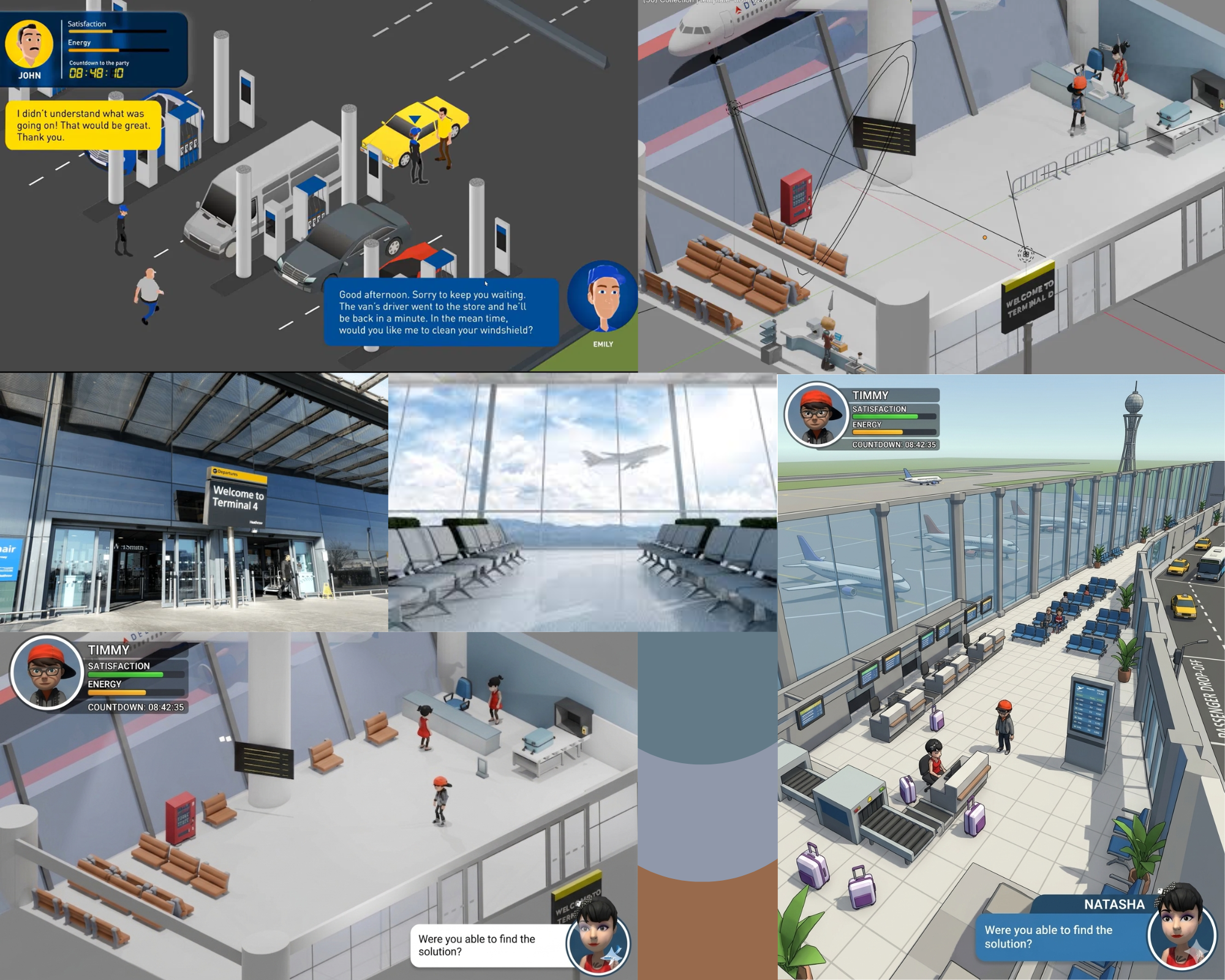
A scenario-based e-learning experience built in Articulate Storyline 360, set within an isometric airport terminal and designed to develop frontline communication and problem-solving skills under time pressure.
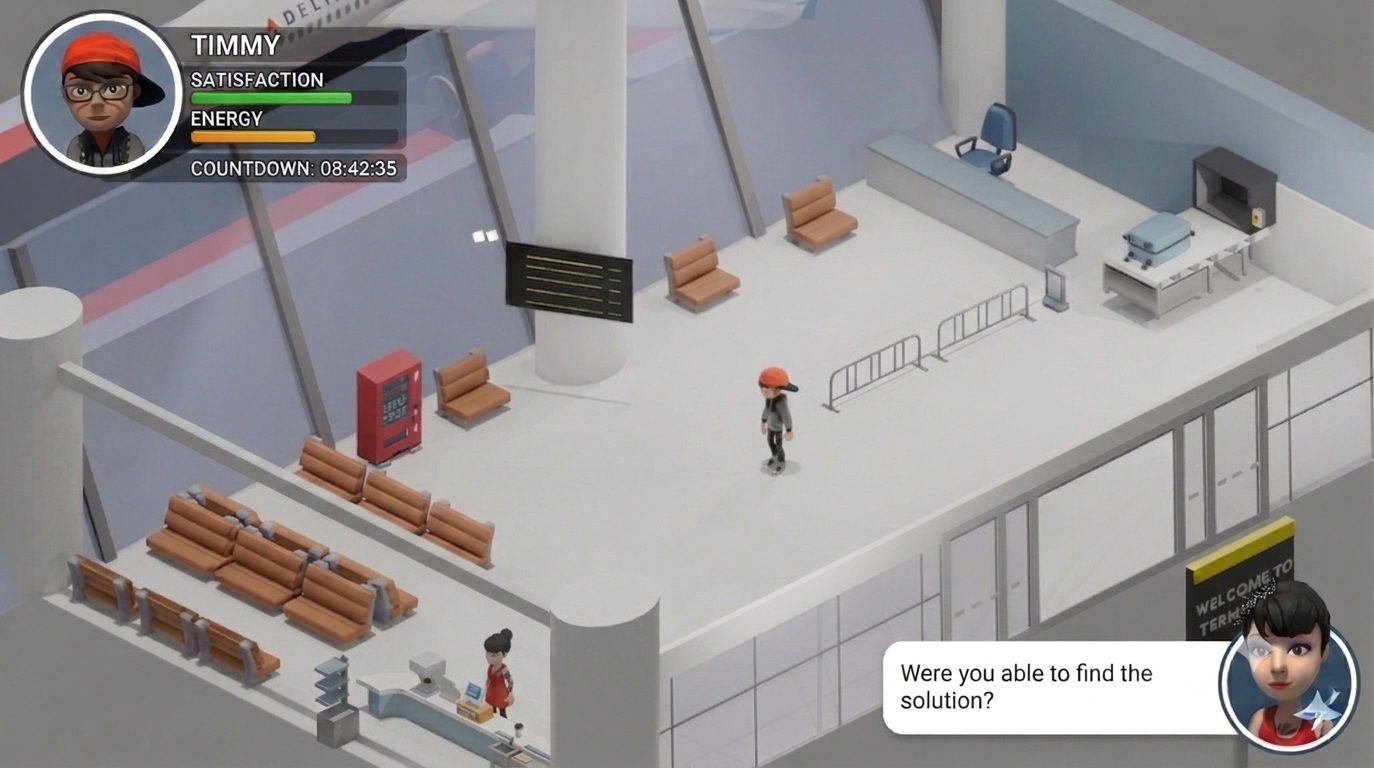
Learners play an airport agent helping Timmy, an anxious young passenger, navigate three escalating problems before his flight departs- a ticketing discrepancy, an overweight bag, and a declined card- making service-focused choices at three key decision points.
Live HUD bars for time, energy and satisfaction provide real-time feedback on the cumulative impact of each choice, turning the trade-offs of frontline customer service into an immediate, visible experience.
The Problem
Frontline aviation and customer service professionals frequently struggle with operational tunnel vision during high-pressure passenger interactions, treating procedural enforcement and passenger satisfaction as a zero-sum game. Without a holistic understanding of systemic trade-offs, staff often default to either bureaucratic dismissal or shortsighted workarounds when handling distressed individuals under tight time constraints. Consequently, customer trust deteriorates, processing timelines fracture downstream, and passenger wellbeing is compromised because frontline interventions are fundamentally mismatched to the traveler's immediate limitations. The core problem isn't a lack of policy knowledge, but an inability to evaluate the cumulative impact of communication and decision-making choices on interconnected variables like time, passenger energy, and long-term brand satisfaction.
The Solution
I created a branchless, scenario-based e-learning experience that simulates a high-stakes airport terminal environment where every decision dynamically shapes the passenger’s journey. This immersive simulation requires learners to navigate authentic service friction points- ranging from ticketing anomalies to digital roadblocks- by actively prioritizing customer de-escalation alongside operational constraints. A real-time heads-up display (HUD) tracks the constant, interconnected fluctuations of passenger Energy, Time, and Satisfaction, providing instant visibility into the systemic consequences of the user's chosen words. Utilizing continuous-flow evaluation rather than rigid pass/fail mechanics, this approach reinforces adaptive problem-solving and systems thinking, training professionals to optimise operational efficiency while maintaining a human-centred service environment.
Visual Mockups